
Cisco Nexus
Data-center switching for top-of-rack, leaf and spine roles — where east-west bandwidth and port density matter more than PoE.
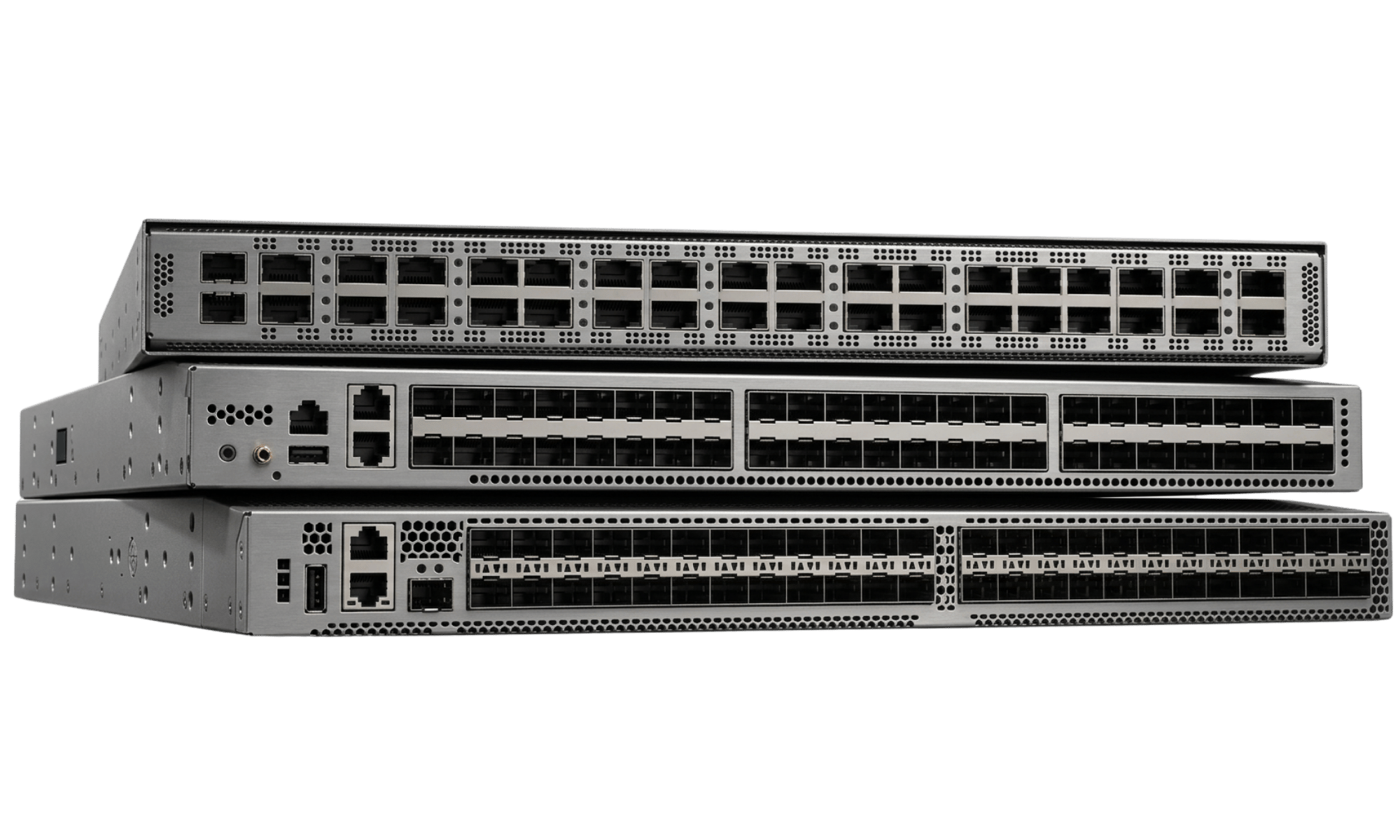
Nexus is Cisco's data-center line, built for server-facing and spine-facing switching rather than campus access. The 9300 covers top-of-rack and leaf roles; the questions that decide a model are server-side port speed, uplink speed, and airflow direction.
Individual networking products aren't listed for sale on this site yet — tell us the model, port speeds and airflow direction and we'll confirm current availability and pricing.
Catalyst vs. Nexus
Both are Cisco switching platforms, but they're built for different traffic patterns. Catalyst (9200/9300/9500) is the campus line — access, aggregation and core, with PoE where the role needs it. Nexus is the data-center line — top-of-rack, leaf and spine, built around high east-west bandwidth between servers rather than powering endpoints. If you're connecting phones, access points or desktops, you want Cisco Switches, not Nexus. If you're building server racks or a leaf/spine fabric, you're in the right place.
Data-Center Roles
Where a Nexus switch sits changes what matters — port count and PoE give way to uplink bandwidth and airflow.
Sits at the top of a server rack — server-facing downlink ports on one side, uplinks to the spine or aggregation layer on the other.
In a leaf/spine fabric, connects directly to servers and uplinks to every spine switch for predictable east-west latency.
Aggregates every leaf switch — high port density and bandwidth, no server-facing role.
Nexus 9000 & the 9300
The Nexus 9000 family spans modular chassis down to fixed top-of-rack switches; the 9300 is the fixed-configuration top-of-rack model most commonly quoted — server-facing ports on one side, spine uplinks on the other. Port speed at the server side and uplink speed at the spine side are usually the two figures that decide the model.
9300 Port Configurations
| N9372PX | 48× 1/10-Gbps SFP+ server-facing · 6× 40-Gbps QSFP+ uplinks |
|---|---|
| N9372TX | 48× 100M/1/10GBASE-T server-facing · 6× 40-Gbps QSFP+ uplinks |
| N9396PX | 48× 1/10-Gbps SFP+ server-facing · up to 12× 40-Gbps QSFP+ uplinks |
| N93120TX / N93128TX | 96× 100M/1/10GBASE-T server-facing · 6 or 8× 40-Gbps uplinks |
QSFP+ uplinks need optics or DAC cables — these are separate items and commonly missing from a decommissioned unit. See Optics & Transceivers for form factors and compatibility.
Airflow direction is not a detail — it decides whether the unit can go in the rack at all
Cisco offers port-side intake and port-side exhaust configurations, identified by blue/red tabs and a part-number suffix — for example N9K-PAC-650W vs. N9K-PAC-650W-B ("-B" = reversed direction). Fans and power supplies must match each other and the direction your rack's containment expects. Getting this wrong pushes hot air the wrong way down a contained aisle.
NX-OS, ACI & Licensing
Nexus 9000 Series hardware can run standard NX-OS or, on supported models, ACI (Application Centric Infrastructure) mode for a centrally-controlled, policy-driven fabric. Which mode a used unit is running affects how it fits into an existing data center — worth confirming before you quote. Licensing is purchased separately from the hardware and tiered by NX-OS feature set.
Hardware ownership vs. software licensing
TekBoost supplies the hardware only. Cisco software licenses and subscriptions are not included and are not sold by TekBoost, and must be obtained separately from Cisco or an authorized Cisco partner where a design requires them. We can report the software version present on a quoted unit; we cannot supply the entitlement to run it.
What TekBoost Confirms
Individual networking products aren't listed for sale on this site. Availability of any particular model is confirmed by quote rather than published here.
The precise model, revision and physical condition of the units offered.
Port-side intake or exhaust, and which power supplies are fitted.
Which transceivers or DAC cables are included, if any.
NX-OS or ACI as installed — licensing entitlement is separate and not supplied by TekBoost.
What to Tell Us
- Model or part number — the exact SKU if you have it, or the role (top-of-rack, leaf, spine).
- Port speeds & count — 10G, 25G, 40G or 100G, and how many server-facing ports.
- Uplinks — SFP+, QSFP+ or QSFP28, and whether optics or DAC cables are needed.
- Airflow direction — port-side intake or port-side exhaust, matched to your rack.
- Software — NX-OS or ACI, and which license tier your design needs.
- Quantity — one-off or repeat requirement; volume pricing is available.
- Compatibility — what this has to work alongside.
Networking equipment bought through a TekBoost quote carries our standard 3-year warranty — buying by quote rather than from an online listing makes no difference to cover — subject to the terms, exclusions and conditions on that page. Manufacturer warranty, software licensing and support entitlements are separate and are not included.