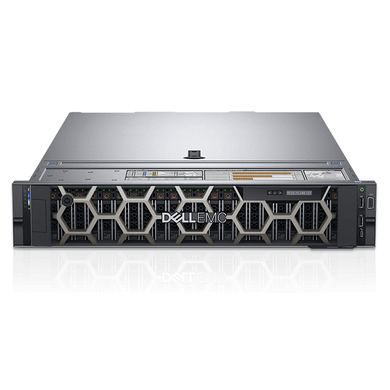
Dell PowerEdge R740XD Server
The Dell PowerEdge R740XD is a high-density 2U storage and virtualization server built for businesses that need flexible drive configurations, strong dual-socket performance, and scalable DDR4 memory.

High-Density Storage With Enterprise Compute Power
The PowerEdge R740XD is ideal for virtualization, backup, software-defined storage, database workloads, file storage, and business-critical infrastructure.
Storage-Focused 2U Design
Choose from SFF, LFF, rear flex bay, and NVMe-capable configurations depending on your workload and drive requirements.
Flexible Custom Builds
Configure CPUs, DDR4 ECC memory, SAS/SATA drives, enterprise SSDs, NVMe storage, RAID controllers, NICs, rails, bezel, and power supplies.
Virtualization Ready
Popular for VMware, Hyper-V, Proxmox, backup appliances, storage nodes, database servers, and mixed business workloads.
Tested Refurbished Hardware
TekBoost builds refurbished enterprise servers around your requested configuration so you can match performance, capacity, and budget.
Build Your R740XD Around The Workload
Start with the chassis, then configure processors, memory, storage, RAID, networking, and accessories.
R740XD Storage Configurations
The R740XD is best known for its flexible drive bay layouts, making it one of the strongest Dell 14th Gen choices for storage-heavy deployments.
24 Bay SFF
Popular for high-density SSD and 2.5" SAS/SATA deployments.
12 Bay LFF
Best for larger 3.5" capacity drives and cost-effective bulk storage.
NVMe-Capable
Useful for high-speed storage, databases, virtualization, and performance-sensitive workloads.
Rear Flex Bay
Adds rear drive flexibility on select chassis configurations for boot or additional storage.
Common R740XD Workloads
R740XD Vs Other Dell 14th Gen Servers
| Model | Best For | Why Choose It |
|---|---|---|
| R740XD | Storage, virtualization, backup | Best 2U choice when drive flexibility is the priority. |
| R740 | General enterprise workloads | Better all-around balance of storage, PCIe, and GPU flexibility. |
| R640 | Dense compute | Best when rack density and 1U compute performance matter most. |
| R540 | Budget storage and virtualization | Lower-cost 2U option for growing infrastructure needs. |
Built-To-Order Refurbished Enterprise Hardware
TekBoost helps businesses source reliable refurbished Dell PowerEdge servers with custom configurations, tested components, and knowledgeable support.
Ready To Configure Your Dell R740XD?
Build your server with the right CPU, RAM, storage, RAID, networking, and accessories for your workload.
Dell PowerEdge R740XD Specifications At A Glance
A quick reference for the R740XD's core platform capabilities. Exact configuration availability depends on chassis and processor selection.
| Generation | Dell PowerEdge 14th Generation (released 2017) |
| Form Factor | 2U rack server, dual-socket, storage-optimized chassis |
| Processors | Up to 2x Intel Xeon Scalable (1st or 2nd Generation), up to 28 cores per processor |
| Memory | 24 DIMM slots, DDR4 ECC RDIMM/LRDIMM, speeds up to 2933MT/s — up to 3TB with LRDIMM |
| Drive Bays | Up to 24 front-accessible 2.5" bays, with select chassis adding up to 4 rear-accessible 2.5" bays; 3.5" chassis options up to 12 bays. Some Dell factory configurations extend further with an additional mid-bay drive tray — exact maximums vary by source and chassis. |
| NVMe | Supported on dedicated NVMe-capable chassis options, up to a fully NVMe-populated 24-bay backplane |
| RAID / Storage Controllers | PERC S140 (software), H330, H730P, or H740P (hardware, cache-backed) |
| Networking | 1GbE and 10GbE daughter cards; 25GbE available via Mellanox ConnectX-4 |
| PCIe Expansion | Supports additional PCIe adapters beyond the network daughter card — slightly more expansion headroom than the standard R740 chassis |
| Power Supplies | Redundant 495W, 750W, or 1100W |
| Remote Management | iDRAC9 (Express standard, Enterprise available) |
Dell R740XD Processor & CPU Support
The R740XD supports up to two Intel Xeon Scalable processors from either the 1st Generation ("Skylake") or 2nd Generation ("Cascade Lake") family, with core counts ranging up to 28 per processor. The two generations should not be mixed within the same system. Since the R740XD is a storage-forward platform, many buyers pair it with mid-core-count processors and put the budget toward drives and RAID instead — but the full CPU range is available for workloads that also need heavy compute, such as software-defined storage with inline services.
Dell R740XD Memory & DIMM Configuration
Each R740XD has 24 DDR4 DIMM slots supporting registered ECC memory (RDIMM or LRDIMM), with speeds up to 2933MT/s depending on the installed processor. Populated with LRDIMMs across both processors, the platform supports up to roughly 3TB of total memory — double the memory ceiling of its 13th Generation predecessor, the R730XD. For most storage and virtualization workloads, a mid-capacity RDIMM configuration is sufficient; the LRDIMM ceiling matters most for memory-heavy caching or hyperconverged deployments.
Dell R740XD RAID & Storage Controller Options
Storage controller options on the R740XD range from the PERC S140 software RAID controller (SATA drives only, no cache) up through the PERC H330 (hardware RAID, no cache), the PERC H730P (hardware RAID with 2GB cache), and the PERC H740P (hardware RAID with 8GB cache). Given the R740XD's drive-dense chassis options, a cached controller like the H730P or H740P is worth the upgrade for most production storage workloads — the cache matters more here than on lower-drive-count platforms, since write-heavy workloads across more spindles benefit more from cache-backed writes.
Dell R740XD Networking, PCIe & GPU Considerations
The R740XD accepts a network daughter card plus additional PCIe adapters, with daughter card options spanning 1GbE (Intel I350, Broadcom 5720), 10GbE (Intel X540/X550/X710, Broadcom 57412/57800S), and 25GbE (Mellanox ConnectX-4). The R740XD's chassis offers slightly more PCIe expansion headroom than the standard R740, which the platform's architecture supports for GPU or accelerator use in select configurations — though on the fully NVMe-populated backplane, drive lanes and GPU lanes compete for the same PCIe resources, so a heavily NVMe-loaded R740XD has less room for GPUs than a SAS/SATA-focused build. Confirm compatibility for the specific card and drive combination your environment needs.
Dell R740XD iDRAC9 Remote Management
The R740XD includes Dell's iDRAC9 out-of-band management controller, a generation ahead of the iDRAC8 found on Dell's 13th Generation platforms including the R730XD. iDRAC9 gives administrators remote console, virtual media, monitoring, and firmware-update access independent of the installed OS. iDRAC9 ships in Express and Enterprise license tiers — Express covers basic remote management, while Enterprise adds full remote console and more granular configuration, useful when managing a fleet of storage nodes.
R740XD Vs R740: When Does The Storage-Focused R740XD Make More Sense?
The R740XD and R740 share the same 2U chassis footprint, the same Intel Xeon Scalable processor family, and the same DDR4 memory architecture — the real difference is storage capacity and expansion. The R740 tops out at 16 front drive bays, while the R740XD reaches up to 24 front bays plus additional rear-accessible bays on select chassis, backed by a mid-plane drive design that the standard R740 doesn't have. The R740XD also offers slightly more PCIe expansion headroom. Choose the R740XD when the workload is storage-bound — software-defined storage, backup targets, file servers, or NVMe-heavy virtualization that needs more local drive capacity than the R740's chassis options provide. Choose the standard R740 when a moderate drive count is enough and the workload is more compute- or memory-bound, since it's the simpler, typically lower-cost platform of the two.
R740XD Vs R730XD: Is The Newer Generation Worth It?
The R730XD is the R740XD's direct 13th Generation predecessor, also built around a storage-dense 2U chassis but using Intel Xeon E5-2600 v3/v4 processors and iDRAC8 instead of the R740XD's Xeon Scalable processors and iDRAC9. The R740XD's mid-plane drive cage extends its storage flexibility beyond what the R730XD's chassis supports, and the R740XD roughly doubles the maximum memory ceiling (up to 3TB versus the R730XD's 1.5TB) while offering more PCIe expansion. The R730XD remains a proven, lower-cost storage platform on the refurbished market for buyers who don't need the newer processor family or the higher memory ceiling. Neither platform is universally better — the choice comes down to how much the newer generation's memory ceiling and drive flexibility matter for your workload versus budget.
R740XD Lifecycle & Refurbished Buying Context
Dell does not publish a fixed end-of-life or end-of-support date for PowerEdge servers, but as a 14th Generation platform first released in 2017, the R740XD is a mature, well-established storage platform with a large installed base and strong parts availability on the refurbished market. It remains a solid choice for backup, software-defined storage, virtualization with heavy local storage needs, and file services where drive capacity matters more than raw compute density. Buyers who need the newest hypervisor certifications or the highest per-core performance should look at a 15th or 16th Generation platform instead; for most storage-heavy enterprise workloads, the R740XD's drive flexibility and memory ceiling still hold up well.
Dell PowerEdge R740XD Questions
What is the Dell PowerEdge R740XD best used for?
The R740XD is best for storage-heavy workloads, virtualization, backup, database applications, and software-defined storage deployments.
Does the R740XD support NVMe drives?
Yes, select R740XD chassis and backplane configurations support NVMe drives. Compatibility depends on the specific chassis, backplane, cables, and riser configuration.
How much memory does the R740XD support?
The R740XD includes 24 DDR4 DIMM slots and supports registered ECC memory. Actual maximum capacity depends on CPU, DIMM type, and configuration.
Can TekBoost customize an R740XD server?
Yes. TekBoost can configure refurbished R740XD servers with CPUs, memory, drives, RAID, networking, rails, bezel, power supplies, and operating system options.
How Many Drives Does The Dell PowerEdge R740XD Support?
Up to 24 front-accessible 2.5" drives, with select chassis adding up to 4 rear-accessible drives. 3.5" chassis options support up to 12 bays. Exact totals depend on the chassis and backplane selected.
How Does The R740XD Compare To The R730XD?
The R740XD is Dell's 14th Generation successor to the R730XD, moving from Xeon E5-2600 v3/v4 processors and iDRAC8 to Xeon Scalable processors and iDRAC9, with roughly double the maximum memory ceiling and more PCIe expansion. The R730XD remains a proven, lower-cost storage option for buyers who don't need the newer processor family.
Refurbished Dell PowerEdge R740XD Servers
TekBoost builds refurbished Dell PowerEdge R740XD servers with configurable CPUs, DDR4 ECC memory, RAID, networking, rails, bezels, power supplies, and SAS/SATA/NVMe storage options.
The R740XD is ideal for virtualization, backup storage, software-defined storage, databases, file storage, and mixed enterprise workloads requiring strong storage flexibility and dual-socket compute performance.
Customers comparing Dell 14th Generation servers may also consider the Dell PowerEdge R740 for balanced enterprise workloads, the Dell PowerEdge R640 for dense 1U compute, or the full 14th Generation Dell Servers lineup.
Buyers weighing generations may also compare the R740XD against the Dell PowerEdge R730XD, its 13th Generation predecessor, or browse the full range of Dell PowerEdge servers.